
Filtres à huile lubrifiante
Alfa Laval lubricating oil filters provide full-flow filtration of lubricating oils for trunk piston and crosshead engines. Types 160, 240, 280 and 350 cover all lubricating oil flows. They can also be fitted with an Eliminator combination, which provides better protection and extends the oil lifetime.
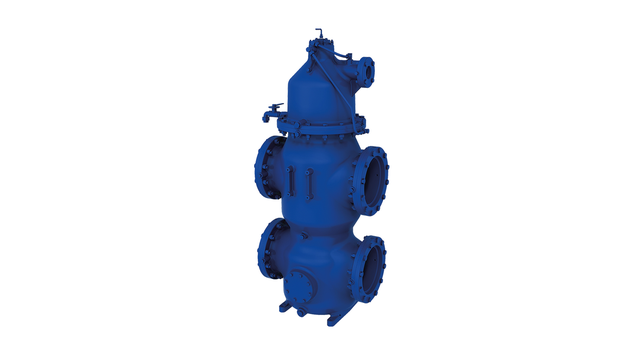
Alfa Laval automatic lube oil filter systems are designed specifically for full-flow filtering of the lubricating oils used in trunk piston and crosshead engines. Their extremely effective filtering prevents contaminants from entering sensitive parts of the engine, thus reducing engine wear and boosting reliability. Their compact, space-saving design makes them easy to install and to retrofit as upgrades to existing installations.
The continuous backflushing that is a core feature of Alfa Laval automatic lube oil filter systems prevents any solids adhering to the filter surfaces – which means no manual cleaning of filter elements is required. The filters therefore run with more than 12,000 operating hours between cleaning and inspection.
In addition, there is only a low, constant pressure drop across the filter elements, which reduces the risk of them cracking. During backflushing there is no pressure drop at all. The near-constant pressure in the engine’s lubricating oil system makes it easier to detect any malfunctions, simply by registering pressure changes.
There are three main types of Alfa Laval lube oil filter, all with an automatic backflushing system. The X type is designed for use with crosshead engines, the T type for use with trunk piston engines and the Eliminator type for use with trunk piston engines of up to 5,000 kW in capacity.
Certain X and T models are available with a special diversion chamber that collects any particles backflushed from the full-flow chamber, acting as an automatic, maintenance-free sludge treatment system. The Eliminator models actually supplement the full-flow automatic filter with another high-performance technology – a special disc-stack centrifuge for removing particles from the oil flushed out of the filter, allowing the oil to be returned to the engine sump.
Fonctionnement
Principe de filtration
L'huile non filtrée pénètre dans le filtre, où un distributeur l'oriente vers 11 des 12 colonnes filtrantes. Les particules solides sont retenues à la surface des éléments filtrants, tandis que l'huile filtrée est dirigée vers le moteur.
Pendant ce temps, les impuretés accumulées dans la douzième colonne sont éliminées grâce à un système de contre-lavage utilisant une faible quantité d'huile déjà filtrée.
Nettoyage automatique par contre-lavage
L'huile utilisée pour le contre-lavage circule à travers un passage du distributeur avant d'être évacuée par la sortie dédiée, puis renvoyée vers le carter d'huile de lubrification.
Le distributeur, entraîné par le moteur hydraulique situé sur le dessus du corps du filtre, tourne à intervalles réguliers. À chaque position, il alimente 11 colonnes en huile à filtrer tout en déclenchant le contre-lavage de la douzième.
Ainsi, chaque colonne est nettoyée une fois par tour complet du distributeur, soit toutes les une à trois minutes.
Surveillance du système
Un indicateur de perte de charge, installé entre l'entrée et la sortie du filtre, mesure en permanence la différence de pression. Si celle-ci atteint le seuil d'alarme, un signal est émis afin d'alerter l'opérateur d'un dysfonctionnement potentiel du circuit d'huile de lubrification.
Le contre-lavage automatique est actionné par la différence de pression entre la sortie d'huile propre (P2) et la sortie d'huile de contre-lavage (P3) du filtre.
Équipements et options
Je trouve cette version plus adaptée à une page produit : elle est moins "manuel d'utilisation" que l'anglais, tout en restant parfaitement fidèle au fonctionnement technique du filtre. Les H3 permettent en outre aux lecteurs de trouver rapidement l'information recherchée.