
Alfa Laval turns the heat way up at Zaldivar
At 3,300 meters above sea level in northern Chile, Barrick Zaldivar overlooks 1,240-hectares of copper openpit, heap-leach mines. Alfa Laval plate heat exchangers have been contributing to their operations with smooth, stable and efficient heat recovery for many years.
DATE 2025-12-17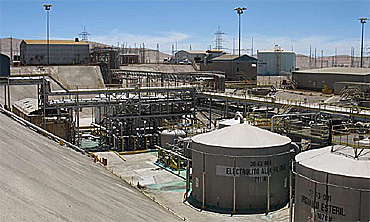
At 3,300 meters above sea level in northern Chile, Barrick Zaldivar overlooks 1,240-hectares of copper open-pit, heap-leach mines. Alfa Laval Plate heat exchangers have been contributing to their operations with smooth, stable and efficient heat recovery for many years.
For over a decade, Zaldivar has been using Alfa Laval Plate heat exchangers to recover heat in the electrowinning step of the copper extraction process. The installation was straightforward and relatively simple, and ever since, the heat exchangers have been stable, efficient and easy to maintain.
The units were easy to install because, unlike shell-and-tube heat exchangers, there was no need to build a special foundation. They included a frame and feet. And they have been running trouble-free since day one of installation.
The units are very reliable. They have been operating without any major problems since 1994. There’s never been a need to change plates.”
- Maintenance manager Roberto Villalobos
Less space taken, less cleaning needed, more heat recovered
At Zaldivar, 48 megawatts of heat are recovered. Despite this impressive number, the Plate heat exchanger takes up less space than a traditional shell-and-tube heat exchanger.
As copper is depleted on the cathodes in the electrowinning cell, the returning lean electrolyte pre-heat the rich electrolyte before entering the electrowinning cell. The plates offer excellent thermal efficiency because of the counter-current flow and the higher internal turbulence. This sharply reduces counter-productive scaling and fouling – and by the same token, the need for cleaning.
Parallel units mean production never stops
The 16 units operate in four production lines. This makes it easy to do maintenance because only a single heat exchanger at a time needs to be stopped. And that does not affect the overall production significantly.
Visual inspection is made of the heat exchangers every day and maintenance is carried out on one of the 16 heat exchangers each year. The units are designed to make physical maintenance as straightforward as possible. The plates hang on carrying bars, making it easy to open the bolts and clean when necessary.
The Alfa Laval Plate heat exchangers have offered easy installation and maintenance, and super-efficient heat recovery. They outperform traditional shell-and-tube heat exchangers for Zaldivar on every count.
Fast facts about Barrick Zaldivar
Zaldívar is an open-pit, heap-leach copper mine in northern Chile owned by the Barrick mining company.
- In 2007, Zaldívar produced 315 million pounds of copper at total cash costs of US$ 0.70 per pound.
- Pure cathode copper is produced by three stages of crushing and stacking of ore, followed by heap leaching and bacterial activity to remove the copper from the ore into the solution.
- The electrowinning plant has been modified to produce 331 million pounds (150,000 tonnes) of cathode copper per year. That’s 20% more than the original design capacity.
Customer's voice
The units are very reliable. They have been operating without any major problems since 1994.
Roberto Villalobos
Maintenance manager
Fast facts about the solution
Sixteen Alfa Laval Plate heat exchangers are used in four production lines at Barrick Zaldivar.
- The counter-current flow and corrugated design of the plates create strong turbulence that allows for 48 megawatts of heat recovery.
- Higher turbulence means that there is less fouling and scaling, and thus less need for cleaning.
- The plates hang on a carrying bar and are supported by a guiding bar, making the unit easy to open for maintenance.
Product
Alfa Laval provides a comprehensive range of plate heat exchangers of the traditional type, featuring gaskets between the plates.